Making a difference on your farm

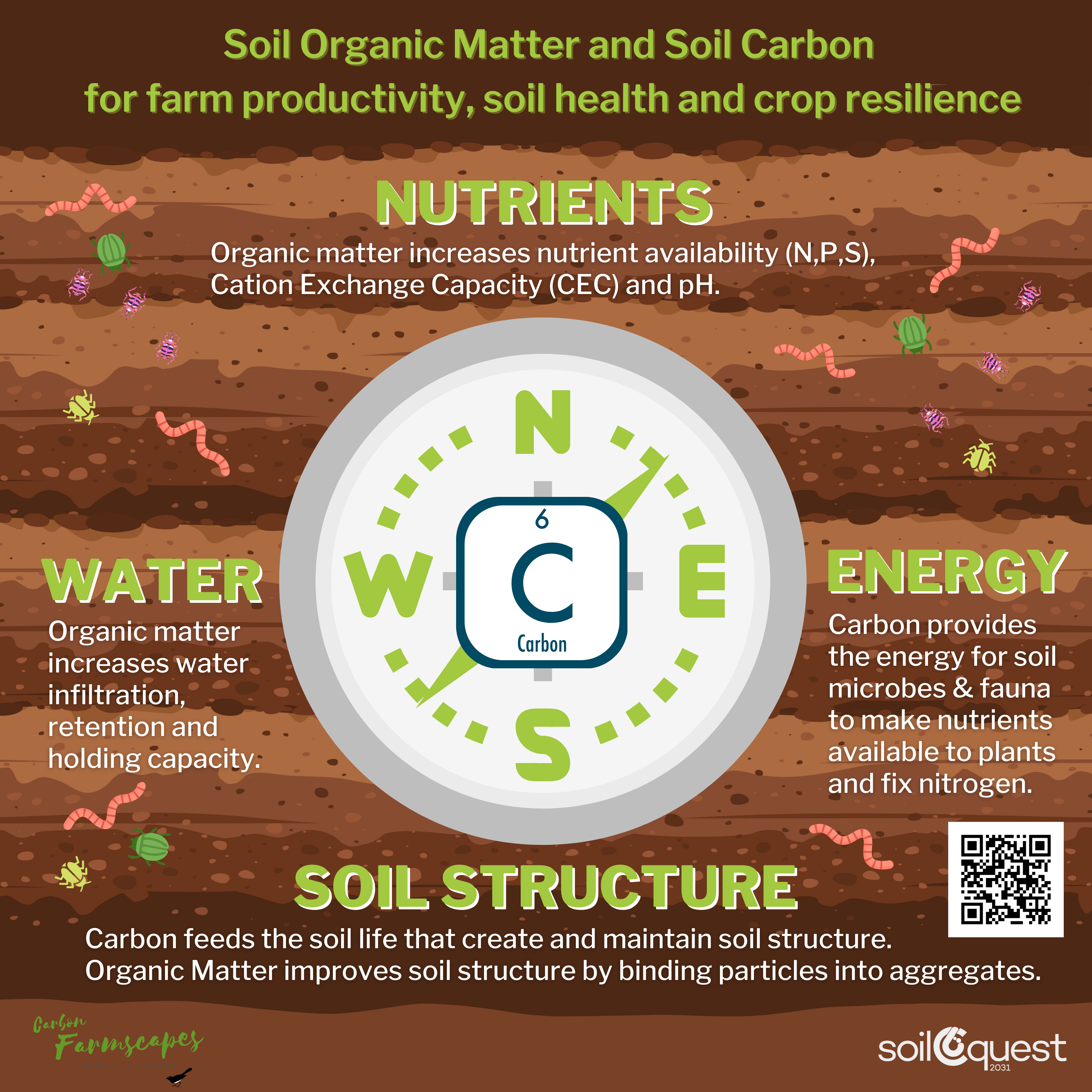
The SoilCQuest Soil Carbon Compass©

Carbon Farmscapes

Empowering Australian producers and their trusted advisors

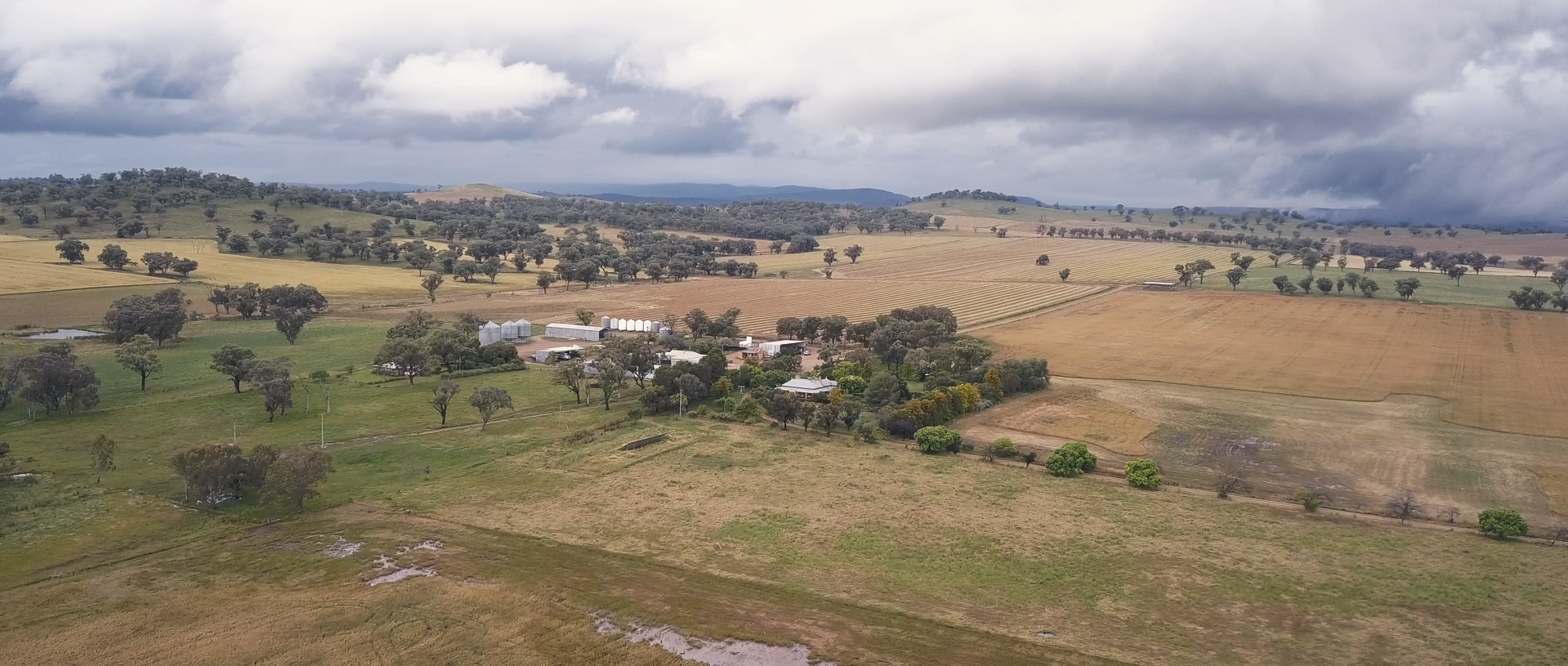
SoilCQuest is championing the agronomic, economic, environmental and social value of a holistic carbon farming landscape (farmscape), underpinned with farm soil carbon building practices, by engaging with farmers, trusted advisors, educators, industry organisations, NRM and other service providers to remove barriers to adoption.

Soil carbon is a key metric of soil health, therefore farmers who are focused on soil health as well as adopting soil carbon practices that regenerate their soils, go into drought later and come out of drought quicker.

Farmscapes that incorporate biodiversity, agroecology and water management practices are more likely to benefit from greater primary productivity and more soil carbon.

SoilCQuest’s Carbon Farmscapes initiative is a focus on supporting the understanding and implementation of soil carbon science in on-farm application together with broader agroecological and hydrological practices. This Carbon Farmscape planning and engagement delivers a comprehensive farm-wide strategy for carbon sequestration, productivity and sustainable agriculture.

Want to know more about growing soil carbon?

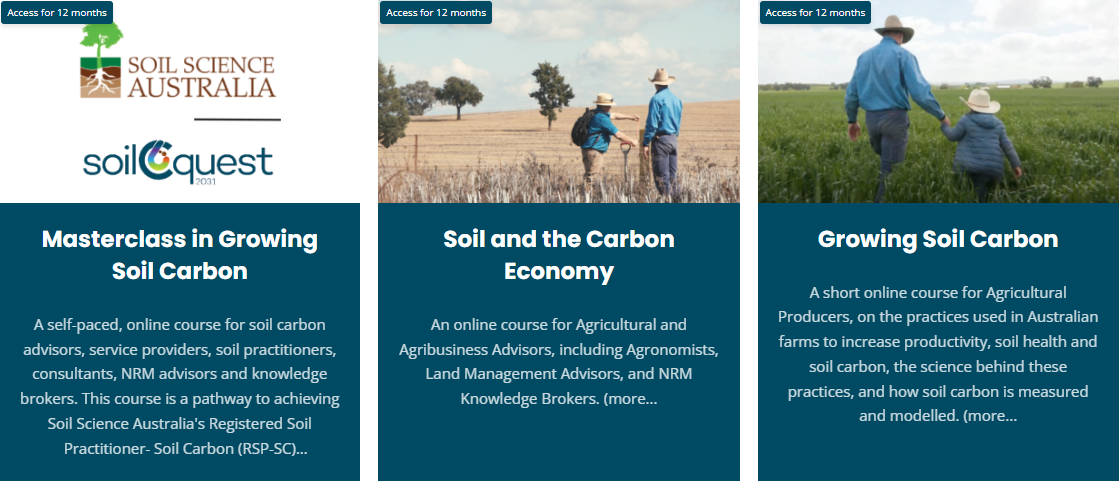
Our online, self-paced courses simplify the often-complex world of farm soil carbon, farm emissions and carbon farming projects.

These courses are for Australian agricultural producers and their trusted advisors, sharing knowledge on how soil carbon is a key metric to farm productivity and profitability.

Gain insights from Australian farmers growing soil carbon to improve yield, profits and resilience

Uncover how soil organic matter and soil carbon increase soil health and address agronomic challenges

Learn what cropping, mixed and grazing practices increase and protect soil carbon

Understand agricultural greenhouse gas emissions and Australia’s new carbon economy

Get clarity on ACCU Scheme (ERF) Carbon Farming projects and the Soil Carbon Method

Farm soil carbon, a win-win

Soil organic carbon is a cornerstone of resilient and productive agricultural systems.

As a key component of soil organic matter, soil carbon underpins soil health by enhancing structure, water retention, and nutrient cycling.

For Australian farmers, agronomists, and land managers, actively managing soil carbon is not just a strategy for climate mitigation, but a direct investment in the natural capital of the farm.

All Australian farms can grow soil carbon. Just how much each farm can build depends onis up to the climate, soil type and how the farm is managed.

The global benefits of increasing soil carbon

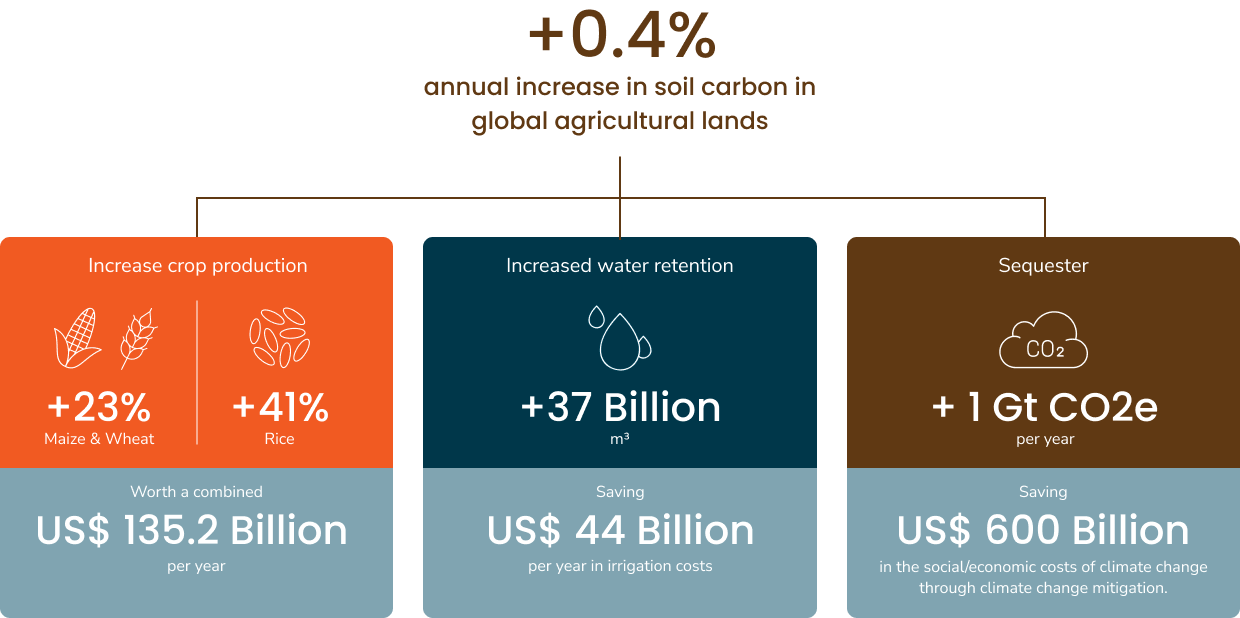
Increasing soil organic carbon by 0.4% per year in the top 30-40cm of our global agricultural soils between 2020- 2050 could have the following agronomic and social benefits:

    1. Boost maize, wheat and rice production by 23.4%, 22.9% and 41.9% respectively- worth USD $135.2 billion or approx. AUD $204.2 billion per year.
    2. Store an additional 37 billion m3 of water in soils, reducing global irrigation demand by 4% and saving an estimated USD $44 billion or approx. AUD $66.5 billion per year.
    3. Sequester approximately 1 Gigaton CO2e per year which would avoid social/economic costs of USD $600 billion or AUD $906.2 billion per year through climate change mitigation.
Source
How more soil carbon would benefit agriculture and society
Nature’s free inputs

Managing above and below-ground biodiversity and the small water cycle allow farmers to harness the free inputs that nature provides.

Biodiversity
  • Remnant Connection Connecting existing remnant vegetation incorporated as windbreaks & shelterbelts.
  • Tree Lines creating biodiverse multispecies tree lines as strategic windbreaks & shelterbelts.
  • Fodder Trees connecting remnant vegetation via fodder tree / shrub alleys as biodiversity connectivity.
  • Paddock Perimeter & Block Plantings creating moisture trapping microclimates via vegetation paddock perimeters and internal paddock block plantings that host various native animals.
  • Agroforestry & Hort Trees timber & fruit/nut treescreating ecological environments for biodiversity.
Avoided Deforestation
  • Conserving remnant vegetation
  • Feral Animal Control to protect native animals
  • Exclusion fencing
  • Strategic grazing for fire hazard reduction and understorey health
Water
  • Managing on-farm water flow maximises water efficiency, pasture & crop growth and subsequent carbon sequestration.
  • Contour Banks redistributing water flows evenly across the landscape to rehydrate the watershed aquifers.
  • Leaky Weirs slowing water speed in drainage lines.
  • Swales farm-over contour banks
  • Strategic dam structures
  • Strategic Vegetation Water Interception Traps using biodiversity and or agroforestry plantings to trap excess overland water flows.
  • Blue Carbon reefs, mangroves, wetlands and land-to-ocean runoff management.
 
Energy
  • Integration of on-farm renewable energy and agricultural production systems for increased soil carbon sequestration

  • Energy audits to assess the on- farm energy use C02 footprint of fuel, fertiliser, electricity and

  • embodied energy in the supply chain.

  • Solar combined with grazing systems

  • Wind turbines combined with grazing systems

  • On- farm hydrogen production powering tractors and trucks

  • On- farm renewable energy powering vehicles & irrigation pumps

Waste Management
  • Nutrient capture- animal manures, composting, wastewater management
  • Recycling plastic wrap and other on farm waste streams

Cropping

Conservation Farming
  • Min / zero till

  • Legume rotation

  • Stubble retention

  • Controlled traffic

  • Stripper fronts

Regenerative Farming
  • Cover Cropping
  • Intercropping
  • Crimp Rolling
  • Root Mass Stimulation
  • One-Way-Valve Cover
  • Fallows
 
Soil Carbon Inoculum

Crop specific soil carbon-fixing fungal inoculums.

Compost Applications
  • Solid loose

  • Compost granules

  • Johnson Su

  • Vermi-compost

  • Windrow

  • In furrow liquid extracts & ferment

pH Soil Amendments
  • Lime

  • Gypsum

  • Dolomite

  • Rock Phosphate

Grazing

100% Groundcover, 100% of the time.
High stocking density with short grazing periods & long rest periods.

FAST Carbon- Fodder Alley Sequestration Trees
  • Tagasaste- Lucerne Tree

  • Leucaena- Sub tropical legume fodder shrub

  • Desmanthus- Fodder Legume shrub

  • SaltBush- Undersown & inter row seeded with hard seeded legume annuals & Lucerne

  • Kurrajong Fodder Tree- slow growing, long lived

  • Native Fodder Trees- Soil & environment specific, e.g. Mulga, Myall, Wilga, Wattle, Rosewood

Fodder & Grain
  • Time controlled grazing

  • Dual purpose multi-species fodder and grain crops

  • Pasture cropping

  • Perennial Multispecies Legume based

Methane Management

Feed additives